
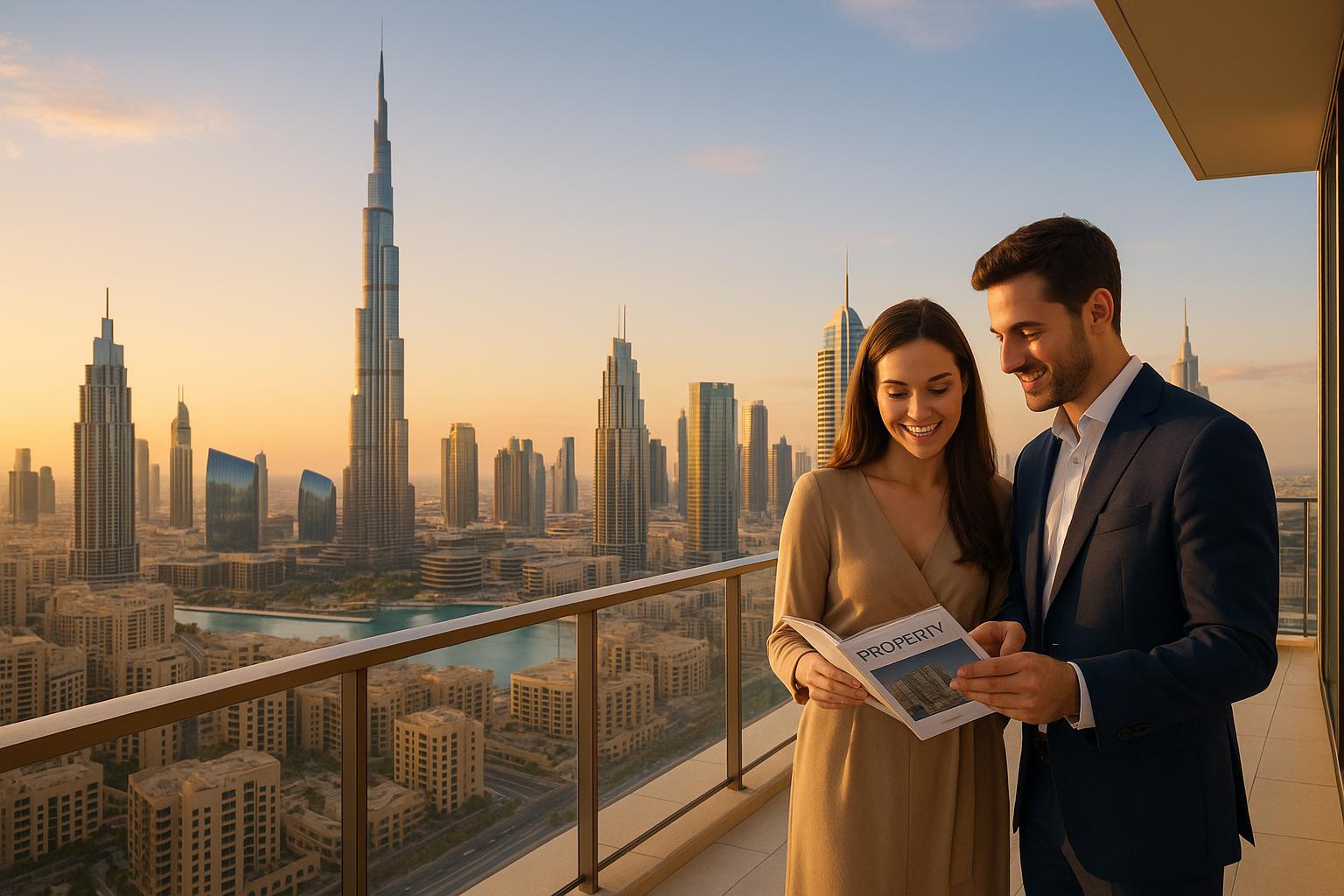
Dubai’s real estate market is booming, making it a top choice for first-time buyers. With tax-free ownership, high rental yields (6%-10%), and a stable currency, it’s an attractive option for investors worldwide. In 2025, over 45% of property buyers were international investors, drawn by new government initiatives like special benefits for homes under AED 5 million. These include priority access, flexible payment plans, and improved mortgage options.
Key highlights:
- Ownership Options: Freehold (full ownership) vs Leasehold (limited-term use).
- Property Types: Apartments dominate sales (76%), followed by villas and off-plan properties.
- Costs: Expect upfront fees like 4% DLD registration, 2% agency fees, and 20% down payment for residents.
- Mortgage Rates: Competitive, ranging from 2.49%-4.29%.
- Top Areas: JVC, Dubai Marina, Dubai Hills Estate, and Business Bay.
This guide simplifies the buying process, covering legal steps, budgeting, and location selection to help you make informed decisions in Dubai’s thriving property market.
Property Types and Market Trends
Main Property Types in Dubai
Dubai's property market is as diverse as its skyline, catering to a range of preferences and budgets. Apartments take the spotlight, making up about 76% of property sales in the city. From compact studio units to lavish penthouses, apartments appeal to both first-time buyers and investors looking for rental income opportunities.
For families and those seeking more space, villas and townhouses are the go-to option. This premium segment has seen growing demand, especially with the completion of 9,300 residential units in Q1 2025, where 79% were apartments. Larger properties are increasingly popular among investors aiming for family-oriented or long-term use.
Off-plan properties also play a significant role in Dubai's market. These properties, which buyers can secure before they are built, offer flexible payment plans and potential for capital growth. In Q1 2025, off-plan sales hit 29,100 transactions, making up a notable 68.9% market share.
For those with deeper pockets, luxury properties priced above AED 20 million remain in high demand. Nearly 590 transactions were recorded in this segment during Q1 2025, highlighting the continued interest from high-net-worth individuals. Developers like Emaar continue to lead the way in driving market activity and resilience.
Freehold vs. Leasehold Ownership
The type of ownership you choose can significantly impact your investment returns and rights. Freehold ownership gives you full control of both the property and the land it’s on, with no expiration date. On the other hand, leasehold ownership allows you to use the property for a set period, typically 30 to 99 years, while the land remains under the developer or community owner’s control.
Here’s a quick comparison:
| Feature | Freehold | Leasehold |
|---|---|---|
| Ownership | Full ownership, no time limit | Limited-term usage (30-99 years) |
| Rights | Unrestricted sale, lease, or transfer | Limited modification rights; lease renewal options |
| Purchase Price | Higher | Lower |
| Financing | Easier to secure mortgages | More restricted lending options |
| Long-term Value | Stronger capital appreciation | Declines as lease period shortens |
Freehold properties accounted for 67% of all property sales in Dubai during 2024, offering 5-8% annual rental yields and an average capital appreciation of 8.3% annually over the past three years. Leasehold properties, while more affordable upfront, often provide slightly higher rental yields of 7-10% annually.
"For long-term investors, freehold remains the gold standard in Dubai. However, we're seeing innovative leasehold structures that can offer compelling value for certain investor profiles, particularly those with 5-10 year investment horizons." - Sarah Johnson, Director at Dubai Property Advisors
"The premium for freehold has increased substantially since 2020, with the pandemic highlighting the value of security and permanence in property ownership. However, well-structured leasehold offers can still present excellent value in prime locations." - Mohammed Al Fahim, Senior Analyst at Emirates Property Research
2025 Market Trends
The Dubai real estate market in 2025 is shaping up to be dynamic, with opportunities for both seasoned investors and first-time buyers. In Q2 2025, property sales reached AED 184.3 billion, marking a 49% annual increase with 53,252 transactions - a 22% rise year-on-year.
Ready property transactions saw a 33% increase compared to Q2 2024, while off-plan transactions grew by 16%. The first half of 2025 set a new record, with 98,603 property sales worth AED 326.7 billion.
The market is gradually moving toward balance as supply catches up with demand. Experts anticipate slower price growth rather than a decline, fostering a sustainable environment. With more properties expected to be delivered in 2025 and 2026, some segments may experience pricing pressure.
Rising rental costs are pushing more residents to consider buying instead of renting, particularly families looking for long-term stability. Meanwhile, the luxury segment continues to flourish, with buyers increasingly drawn to sustainable developments and smart living features. Eco-friendly designs and modern amenities are becoming key selling points.
"With a weakened Dollar, strong rental returns and appealing yields, Dubai continues to attract both local and international buyers. This trend is likely to support the absorption of upcoming off-plan launches throughout the year." - Ronan Arthur, Director, Head of Residential Valuation, Cavendish Maxwell
"What continues to set the UAE apart is proactive governance, including agile policy making, updated licensing protocols, and tighter regulation around agent conduct and property advertising, all of which contribute to greater transparency, investor confidence and robust sectoral performance." - Cherif Sleiman, Chief Revenue Officer, Property Finder
The market’s strength lies in its diversity, with villas and townhouses showing particular promise as supply constraints ease. This dynamic points to a maturing market, where growth is steady rather than speculative.
Legal Requirements and Buying Process
Buyer Eligibility and Required Documents
Dubai is one of the most welcoming markets for foreign property buyers, offering opportunities to invest without requiring UAE residency. Foreigners can purchase property in designated freehold areas, which include some of Dubai's most sought-after locations like Dubai Marina, Downtown Dubai, Palm Jumeirah, and Jumeirah Lake Towers. Whether you're looking for apartments, villas, or even land, complete ownership rights are available in these zones.
The process is straightforward, starting with basic documentation. You'll need a valid passport, a Sale and Purchase Agreement (SPA), and registration with the Dubai Land Department (DLD). During the reservation phase, provide a copy of your passport, and if you're a UAE resident, include your Emirates ID.
Before moving forward, ensure the property is legally sound. Verify the title deed through the DLD to confirm it’s free from liens, mortgages, or disputes, and that the seller is the legitimate owner. Also, check that the property complies with local zoning laws. This due diligence is a key part of Dubai's transparent and secure property market.
Once your documents are ready and eligibility is confirmed, you can move on to the step-by-step buying process.
Property Purchase Steps
The property buying process in Dubai is designed to protect both buyers and sellers, following a clear and structured approach:
- Choose Your Property: Work with a DLD-registered developer or real estate agency to find a property in a freehold area.
- Reserve the Property: Pay a booking fee of 5–10% of the property price, submit your passport copy (and Emirates ID if applicable), and sign the initial Sales and Purchase Agreement (SPA).
- Sign the Sales Contract: Finalize the SPA and register it with the DLD for ready properties, or receive an Oqood certificate for off-plan units.
- Register with the DLD: Complete registration via the DLD office or the REST app. Pay transfer fees, admin fees, and, if applicable, mortgage registration charges.
- Collect Your Title Deed: For ready properties, the title deed is issued immediately. For off-plan units, it is provided after construction and full payment.
It’s a good idea to conduct a professional property inspection, especially for ready-to-move-in units, to assess the condition of the building and utilities.
First-time buyers should note the new scheme introduced in July 2025, which offers Emiratis and residents who don’t own freehold property special benefits. These include priority access, discounts, flexible payment plans, and improved mortgage options.
Purchase Fees and Costs
Understanding the fees involved is crucial for budgeting. While Dubai’s property market is transparent, the additional costs can add up quickly.
The DLD transfer fee, which is 4% of the property value, is the largest single expense after your down payment. As of February 2025, banks no longer finance this fee or the brokerage commission (2%), so these must be paid in cash upfront. The DLD fees must be settled within 60 days to avoid cancellation.
Here’s a breakdown of the main fees:
| Fee Type | Cost | Details |
|---|---|---|
| DLD Registration Fee | 4% of property value | Mandatory transfer fee |
| Agency Fees | 1–2% of property value | Brokerage commission |
| Title Deed Fee | AED 580–1,000 | Official documentation |
| Registration Fee (< AED 500,000) | AED 2,000 + 5% VAT | For lower-value properties |
| Registration Fee (≥ AED 500,000) | AED 4,000 + 5% VAT | For higher-value properties |
| Admin Fee | AED 580 (apartments/offices) | Processing charges |
| Valuation Fee | AED 500–2,000 | Required for mortgage applications |
| Mortgage Registration | 0.25% of loan amount | Applicable for bank financing |
| Mortgage Processing Fee | Up to 1% of loan amount | Bank charges |
For example, if you’re buying a property worth AED 2,000,000, here’s how the costs break down:
- Down Payment (20%): AED 400,000
- DLD Fee (4%): AED 80,000
- Agency Fee (2%): AED 40,000
- Other Fees: Approximately AED 5,000
- Total Upfront Cost: Around AED 525,000.
Keep in mind that annual service charges can range from AED 3 to AED 30 per square foot, depending on the property’s location and amenities. It’s also worth discussing agency fees, as these can sometimes be negotiated. Lastly, always set aside a buffer for unexpected expenses that might arise during the process.
How to Buy Real Estate in Dubai - FULL GUIDE
Budgeting, Financing, and Ongoing Costs
When stepping into property ownership in Dubai, it’s essential to plan your budget carefully. Beyond the purchase price, there are several upfront and ongoing expenses to account for. Let’s dive into the details.
Property Purchase Budget Planning
Owning property in Dubai requires more than just covering the purchase price. You’ll need to account for additional fees and expenses, which can add up quickly.
For starters, plan for an extra 7–10% of the property’s purchase price to cover transaction-related costs. For example, if you’re buying a property worth AED 2,000,000, you should budget an additional AED 140,000–200,000 for these expenses.
The down payment is another key consideration. UAE residents can typically finance up to 80% of the property value for homes under AED 5,000,000, meaning a 20% down payment is required. For non-residents, financing is capped at 50–60%, making cash flow management even more critical.
Don’t forget ongoing costs. Service charges vary by location and property type:
- Premium communities: AED 10–67.88 per square foot
- Mid-range areas: AED 9.73–22 per square foot
- Affordable communities: AED 0.8–12.5 per square foot
Maintenance costs also depend on the size and type of property:
- Apartments: AED 3,000–8,000 annually for studios and one-bedroom units; AED 8,000–13,000 for two-bedroom units; AED 13,000–18,000 for three-bedroom units.
- Villas: AED 15,000 to over AED 35,000 annually, depending on the number of bedrooms.
Utility setup and bills are other essential expenses. DEWA connection fees are AED 2,000 for apartments and AED 4,000 for villas. Monthly utility costs for a two-bedroom apartment typically range from AED 1,200 to AED 2,500, depending on usage and cooling.
Lastly, it’s wise to set aside a contingency fund - about 10–15% of your total estimated costs - to cover unexpected expenses like urgent repairs or additional legal fees.
Mortgage Options for First-Time Buyers
Dubai offers a range of mortgage products for first-time buyers, with recent government initiatives making homeownership more accessible.
The First-Time Home Buyer Programme, launched in July 2025, provides priority access and special pricing for properties up to AED 5,000,000. This initiative aims to support over 5,000 buyers in its first year.
"This initiative represents a powerful economic lever - stimulating long-term demand, driving liquidity into the real estate ecosystem, and accelerating the sector's contribution to GDP in line with the Dubai Economic Agenda, D33."
– Helal Saeed Almarri, Director General of the Dubai Department of Economy and Tourism
Eligibility is straightforward: applicants must be UAE residents aged 18 or older, of any nationality and income level, and must not already own a freehold residential property in Dubai. Registration is done online, and the Dubai Land Department even offers interest-free instalment plans for registration fees when paid with eligible credit cards.
In 2025, mortgage rates are competitive. Fixed rates range from 2.49% to 4.29%, while variable rates start at around 2.25%. Fixed-rate mortgages offer consistent payments, while variable rates may start lower but can fluctuate with market conditions.
Be aware of additional mortgage-related costs:
- Arrangement fee: 1% of the loan value (plus VAT)
- Property valuation: AED 2,500–3,500 (plus VAT)
- Mortgage registration: 0.25% of the mortgage amount (plus a fixed fee)
- Life insurance: 0.4–0.8% per annum on the decreasing loan balance
- Home insurance: Approximately AED 1,000 annually
Improving your mortgage eligibility involves maintaining a stable income, keeping a strong credit history, and reducing existing financial obligations. Steps like clearing debts, avoiding new loans before applying, and saving a larger down payment can also help secure better terms. Footprint Real Estate offers support with mortgage documentation and connects buyers with trusted lenders for competitive financing options.
Budget Breakdown Example
To better understand the financial commitment, here’s a cost breakdown for purchasing a two-bedroom apartment in Dubai Marina priced at AED 2,500,000:
| Item | Amount (AED) | Details |
|---|---|---|
| Property Price | 2,500,000 | Purchase price |
| Down Payment (20%) | 500,000 | Minimum for UAE residents |
| DLD Transfer Fee (4%) | 100,000 | Mandatory registration fee |
| Agency Fee (2%) | 50,000 | Brokerage commission |
| Mortgage Registration (0.25%) | 5,000 | Bank financing fee |
| Property Valuation | 3,000 | Required for mortgage |
| Bank Arrangement Fee (1%) | 20,000 | Mortgage processing |
| Legal/Conveyancing | 8,000 | Professional services |
| DEWA Connection | 2,000 | Utility setup |
| Insurance (Annual) | 1,000 | Home insurance |
| Total Initial Outlay | 689,000 | Including down payment and fees |
In this example, the additional costs (excluding the property price) total AED 189,000 - about 7.6% of the purchase price. This highlights the importance of factoring in all expenses when planning your budget.
If you’re considering a cash purchase, remember that while you avoid interest payments and mortgage fees, you’ll need significantly more liquid capital. This could also limit your ability to diversify investments.
sbb-itb-dd15b90
Location Selection and Professional Support
As we’ve explored Dubai's evolving market trends, picking the right location plays a crucial role in shaping your investment success. The neighbourhood you choose will influence your daily routine, commute, and the potential returns on your property. It’s equally important to work with seasoned professionals who can help you navigate Dubai's intricate property market.
Best Dubai Areas for 2025
Dubai’s real estate market continues to thrive in 2025, with several neighbourhoods standing out as ideal options for first-time buyers. Each area offers unique benefits tailored to varying budgets, lifestyles, and investment goals.
- Jumeirah Village Circle (JVC): Studio apartments start at AED 450,000, while 2-bedroom units go up to AED 1.1 million. This family-friendly area boasts rental yields of 7%–8%, easy access to major roads, and affordable living without sacrificing quality.
- Dubai South: Prices for 1-bedroom apartments begin at AED 400,000. With robust infrastructure investments and proximity to Al Maktoum International Airport, this area offers strong growth potential.
- Dubai Hills Estate: Apartments start around AED 1.2 million for 1-bedroom units, and villas begin at AED 3.5 million. Its closeness to Downtown Dubai and upcoming metro links makes it a highly appealing option.
- Dubai Marina: Apartments in this iconic area start at AED 1.5 million for 1-bedroom units. Rental yields hover around 6.5%, and property prices have seen a 7% rise over the past year.
- Business Bay: Known for its central location, this area offers excellent short-term rental opportunities. Office spaces yield 6%–7%, while residential properties generate 5%–6%, with property prices growing by about 6% annually.
- Dubai Silicon Oasis (DSO): This neighbourhood delivers rental yields of 7%–8%, and property values are expected to grow annually by 5%–6% in the coming years.
Area Selection Criteria
When narrowing down your options, consider these essential factors:
- Budget: Understand your financial limits, including the purchase price and ongoing costs. Dubai's ROI typically ranges from 5% to 9%.
- Lifestyle Needs: Think about your family setup, commuting preferences, and leisure activities. Family-friendly communities like Town Square Dubai are gaining popularity for their affordability, green spaces, and modern amenities.
- Investment Potential: Prioritise areas with high rental yields and strong capital growth. Neighbourhoods near new metro stations, business hubs, or tourist attractions often promise better returns.
- Connectivity and Infrastructure: Look for areas with good transport links, proximity to key business districts, and upcoming developments. Eco-conscious communities like Tilal Al Ghaf are increasingly in demand.
- Community Amenities: Evaluate facilities such as gyms, pools, retail outlets, and recreational spaces. Waterfront properties remain a favourite for their luxury appeal and strong return potential.
These considerations, combined with earlier insights on budget and market trends, will help you choose a neighbourhood that aligns with your personal and investment objectives.
Working with Real Estate Professionals
Once you’ve zeroed in on a promising area, expert advice becomes indispensable. Dubai’s property market demands careful planning and well-informed decisions. Partnering with a RERA-certified broker ensures you get the guidance you need to find the right property, negotiate deals, and handle the necessary paperwork. Signing a Form B contract formalises their role in representing you during the buying process.
Companies like Footprint Real Estate offer comprehensive support, from market insights to tailored advice. Co-founder Hamid Shabir highlights the growing demand for affordable apartments and townhouses in Dubai, spurred by revised loan-to-value ratios that have made properties more accessible.
In addition to property selection, Footprint Real Estate provides services such as mortgage assistance, property registration, valuation, and snagging inspections. Their investment advisory service offers customised advice, complete with market insights and ROI analysis, to help you make confident decisions. With trusted local expertise, you can navigate your property investment journey smoothly and efficiently.
Common Mistakes and How to Avoid Them
Even with meticulous preparation, first-time property buyers often encounter costly missteps. Knowing what these pitfalls are - and how to steer clear of them - can save you both money and stress as you navigate your property purchase.
Typical Property Buying Mistakes
One of the most common errors is focusing solely on the property price while overlooking additional costs. Expenses like DLD registration fees, agency commissions, and ongoing service charges can quickly add up, leaving buyers unprepared financially.
Another frequent mistake is insufficient market research. Rushing into a purchase without understanding price trends or comparing similar properties in the area can lead to overpaying or choosing a property with limited potential for long-term value.
Emotion-driven decisions also pose a significant risk. A visually appealing property might tempt buyers to stretch their budget or ignore practical considerations like commute times or nearby amenities.
Lastly, skipping thorough property inspections is a mistake many first-time buyers regret. Assuming that new developments or well-maintained properties are defect-free can result in costly surprises after handover.
First-Time Buyer Tips
To avoid these pitfalls, consider these key strategies:
- Do your homework: Research the property and developer thoroughly. Look into the developer’s track record, past projects, handover timelines, and feedback from previous buyers.
- Secure mortgage pre-approval: Before you start your property search, get pre-approved for a mortgage. This step not only clarifies your budget but also strengthens your negotiating power.
- Plan for all costs: Build a detailed budget that accounts for more than just the purchase price. Include DLD registration fees, agency commissions, mortgage arrangement fees, property insurance, and ongoing service charges.
- Request an independent valuation: Work with RERA-certified valuers to ensure you’re paying a fair price. These professionals provide detailed reports based on comparable sales data.
- Check legalities: Confirm that the property is in a freehold zone and have a legal expert review the Sale and Purchase Agreement before signing.
While it’s natural to feel excited about a property, ensure your final decision is grounded in logic. Consider factors like your budget, the property’s location, and its long-term investment potential.
Footprint Real Estate Support Services
To help you navigate these challenges, Footprint Real Estate offers a variety of services designed to simplify the buying process:
- Snagging inspections to uncover defects before handover
- Independent property valuations for fair negotiations
- Tailored investment advice with ROI analysis
- Mortgage assistance, including pre-approval support
- Seamless property registration assistance
With these services, Footprint Real Estate aims to provide the guidance and tools you need to make informed decisions in Dubai’s competitive property market.
Key Takeaways for First-Time Buyers
Stepping into Dubai's property market for the first time calls for careful planning and strategy. Begin by evaluating your financial situation - review your savings and income to determine a realistic down payment. For ready properties, you'll typically need around 20%, while off-plan projects might require as little as 10%.
Don’t forget to account for additional expenses like Dubai Land Department (DLD) fees (4%), mortgage registration (0.25%), and agent commissions (3–5%). If you're a foreign national, you can access financing for up to 75% of properties priced under AED 5 million, with mortgage terms stretching up to 25 years.
Beyond financial readiness, collaborating with seasoned real estate professionals is a smart move. They can provide market insights, manage the paperwork, and ensure compliance with regulations. This not only simplifies the process but can also strengthen your negotiation position and help you secure better financing options.
When deciding between ready and off-plan properties, consider your current needs and long-term objectives. Off-plan developments often come with flexible payment plans, potential for capital appreciation, and even residency benefits like the 10-year Golden Visa.
Timing and market research are equally crucial. For instance, mortgage buyers made up 43% of all ready sales transactions in Q2 2024, a notable increase from 35% in 2023. This trend highlights the growing accessibility of property financing in Dubai.
Ultimately, succeeding in Dubai’s real estate market comes down to thorough preparation, a clear budget, and expert advice. Exploring first-time buyer programmes and obtaining mortgage pre-approval can give you a strong advantage as you navigate the purchase process.
FAQs
What is the difference between freehold and leasehold ownership in Dubai, and how does it affect your investment?
In Dubai, freehold ownership grants you full rights over a property. This means you can sell, lease, or even pass it down to your heirs without any limitations. Many buyers favour this option because it offers greater flexibility and is seen as a solid choice for long-term investments.
On the other hand, leasehold ownership lets you lease a property for a set period - usually up to 99 years. After this term ends, the ownership reverts to the freeholder unless you renew the lease. While leasehold properties often come with a lower upfront cost, they typically offer less control and may generate reduced returns as the lease period nears its expiration.
When deciding between freehold and leasehold, think about your financial goals, budget, and future plans to determine which option aligns best with your needs.
What additional costs should first-time buyers in Dubai consider when planning their property budget?
When purchasing property in Dubai, first-time buyers need to be aware of several extra costs that can impact their budget. One of the most notable is the Dubai Land Department (DLD) fee, which amounts to 4% of the property's value. Additionally, real estate agent commissions typically fall between 1% and 2%.
There are other expenses to keep in mind, such as mortgage registration fees, security deposits, and utility connection fees for services like DEWA. On top of that, there are annual maintenance fees, which can vary widely - from AED 3 to AED 30 per square foot - depending on the property type. It's also worth noting that starting February 2025, banks may no longer finance certain fees, such as the DLD fee, meaning buyers will need to cover these costs upfront.
By factoring in these expenses early on, buyers can better prepare their finances and avoid any unwelcome surprises during the purchasing process.
What are the top neighbourhoods for first-time property buyers in Dubai in 2025, and how should you choose the right location?
Looking to step into Dubai's property market for the first time? Some top neighbourhoods to explore in 2025 include Dubai Hills Estate, Jumeirah Village Circle (JVC), Town Square Dubai, Meydan (MBR City), Dubai South, and Arjan (Dubailand). These areas stand out for their budget-friendly options, family-oriented settings, and promising opportunities for growth.
When deciding where to buy, think about what matters most to you. Is it being close to schools, healthcare facilities, or shopping centres? Or perhaps easy access to public transport and major road networks? Don’t forget to consider the overall vibe of the neighbourhood, its potential as a long-term investment, and how well it matches your lifestyle and financial plans. Keeping these factors in mind can guide you towards a decision that feels just right for your needs.