
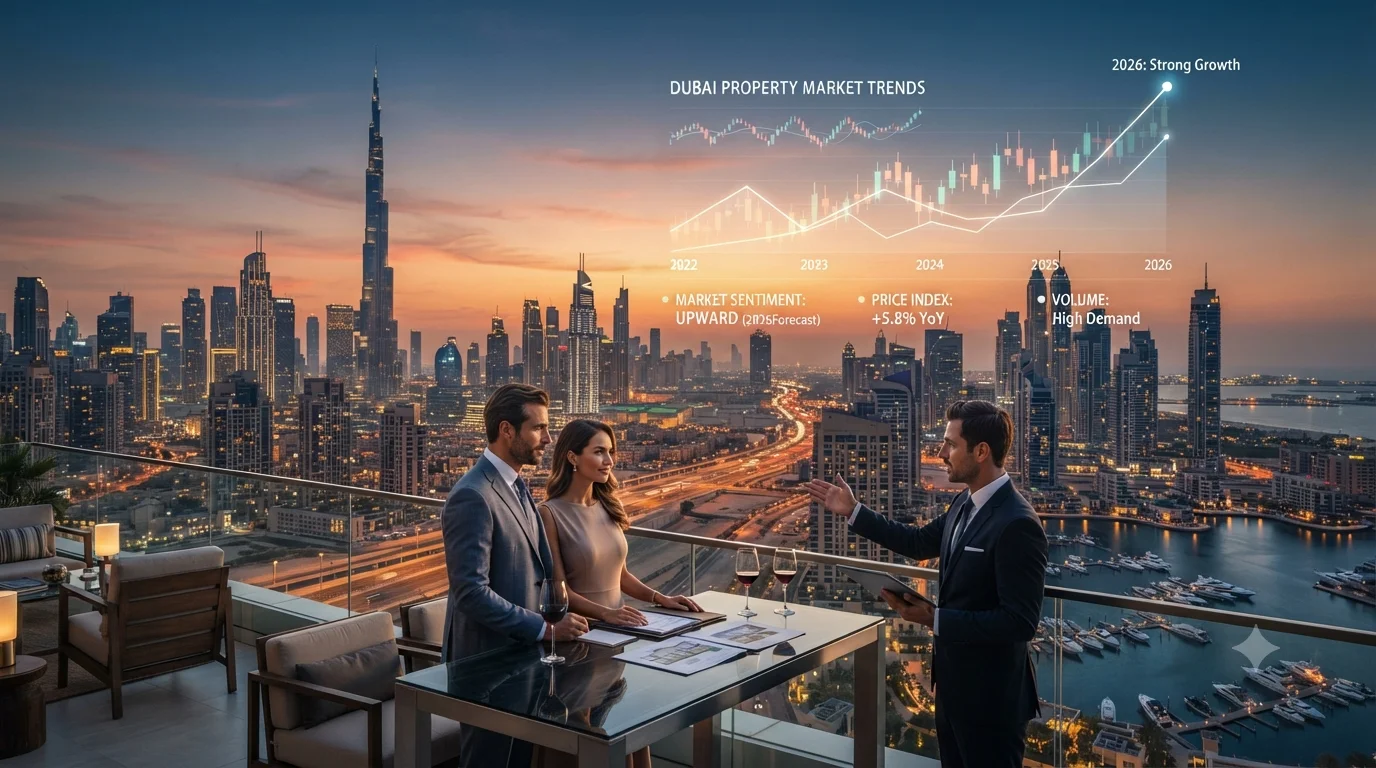
For three years, the only direction Dubai property prices seemed to know was up. Then the mid-year numbers landed — and the headlines changed overnight. Sales in the first half of 2026 came in noticeably below 2025, the first year-on-year decline in three years. Suddenly, the question on every buyer's and investor's mind is the same: Is this the start of a correction, or simply a market catching its breath?
The short answer: most analysts expect Dubai property prices to keep rising in 2026 — just more slowly than the double-digit surges of recent years. But the fuller answer depends on which segment, which community, and when you buy. This guide breaks down the actual data behind the H1 slowdown, what the leading forecasters are predicting for the rest of the year, and what it all means if you're deciding whether to buy now or wait.
What the H1 2026 Numbers Actually Say

The figure that triggered the "prices are falling" narrative was the transaction total. According to the Dubai Land Department, property sales reached roughly AED 286.4 billion (about USD 77.9 billion) in the first half of 2026 — around 12% below the AED 326.6 billion recorded in the same period of 2025.
But context matters, and here it changes the story completely:
-
● It was still the second-largest first half on record for Dubai real estate.
-
● It was the first H1 year-on-year decline in three years — after an exceptional run that was always going to be hard to repeat.
-
● A softer transaction value is not the same as falling prices. Fewer or smaller deals can pull the total down even when per-square-foot values hold or rise.
In other words, the market didn't shrink — it normalised from an extraordinary peak. Most economists read a cooldown after years of rapid growth as a sign of a healthier, more sustainable market, not a warning light.
Off-Plan Is Still Driving the Market
Beneath the headline number, the momentum clearly favours new developments. Off-plan transaction volumes rose roughly 30% year-on-year, as buyers locked in developer payment plans and below-market launch prices. The secondary (resale) market grew a more modest 8%, held back by a persistent gap between what sellers want and what buyers will pay.
That split tells you where confidence sits: buyers are still willing to commit capital to Dubai property — they're just increasingly choosing off-plan entry points over ready resales. If you're weighing your options, our guide to the latest off-plan projects in Dubai is a useful starting point.
The Luxury Segment Set a New Record
Far from cooling, the top end of the market broke records. Dubai logged 296 home sales above AED 36.7 million in H1 2026 — the highest-ever H1 figure for that price bracket. Combined, those deals were worth AED 18.7 billion, up 14% year-on-year. Ultra-prime demand, much of it from global wealth relocating to the UAE, remains one of the market's strongest pillars.
Will Dubai Property Prices Rise or Fall in the Rest of 2026?

Here's where the forecasts converge. Across major consultancies and brokerages, the consensus for full-year 2026 is moderate price growth, not decline:
|
Forecaster / View |
2026 Price Outlook |
|
Consensus range (most analysts) |
+3% to +8% citywide |
|
ValuStrat |
+10% residential capital values; villas +17.7% |
|
Downside / worst-case scenario |
Roughly flat to −5% in oversupplied pockets |
|
Recent years (for comparison) |
+12% to +22% growth |
The realistic picture: growth of somewhere between 3% and 8% for the year, with villas expected to outperform apartments. A genuine correction — falling prices across the board — is the low-probability outcome, most likely confined to specific communities with heavy new supply or speculative buying.
So the accurate framing isn't "rise or fall." It's "rise, but slower and less evenly than before."
The Three Forces That Will Decide Where Prices Go
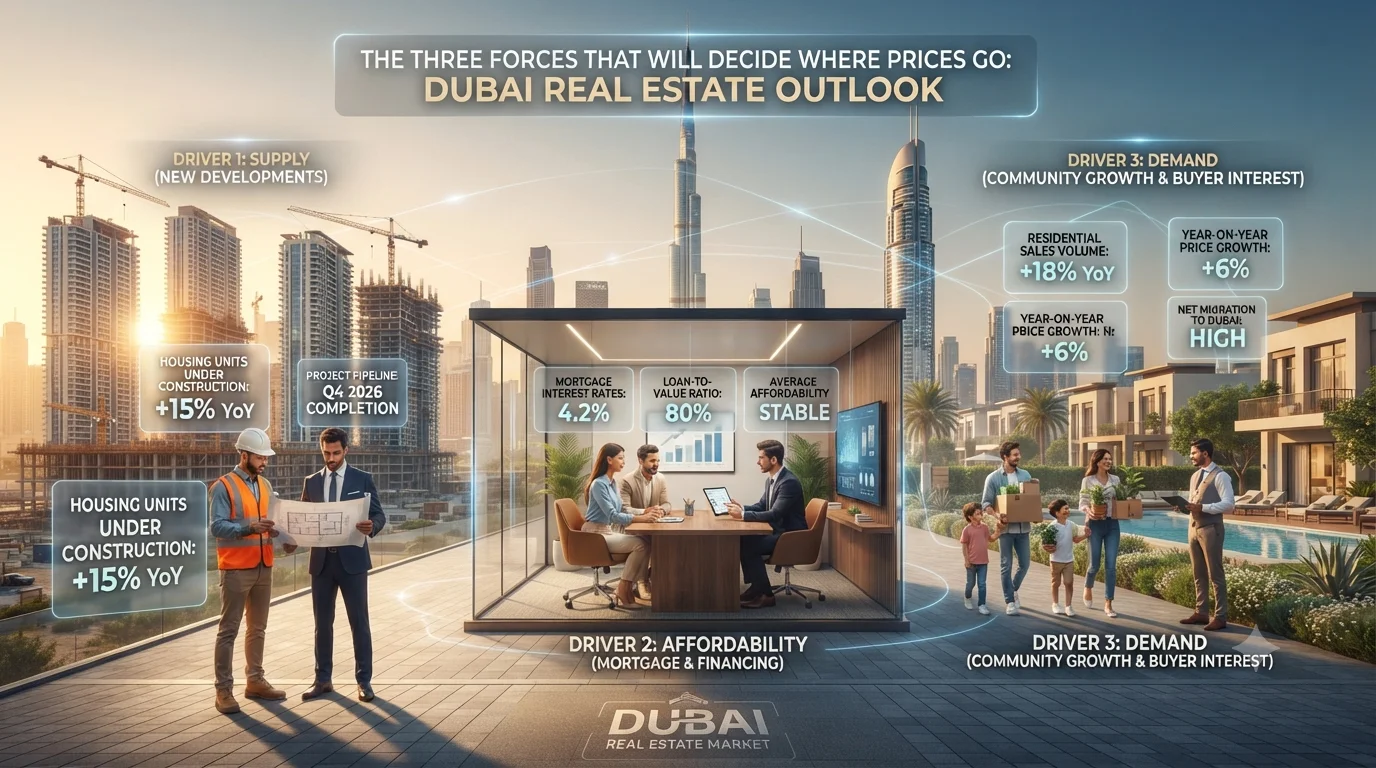
1. The Supply Wave (the biggest wildcard)
The single most-cited risk to Dubai prices in 2026 is new supply. On paper, the pipeline is enormous — headline forecasts point to well over 100,000 units scheduled across apartments and villas.
But there's a catch that buyers often miss: Dubai has a long history of handover delays. Realistically, only a fraction of scheduled units actually complete on time — many analysts expect true 2026 completions closer to 33,000–50,000 units, as 30–40% of projects slip. That gap between forecast and reality is exactly why widely-predicted "oversupply crashes" rarely arrive on schedule.
Where supply does land heavily — mostly in apartment-dense communities with several projects completing at once — expect softer price growth or short-term dips. Villas are the opposite story: with far fewer new units coming (roughly 15,000 scheduled for 2026), scarcity is likely to keep villa prices outperforming.
2. Mortgage Rates and Buyer Affordability
Borrowing costs have quietly turned into a tailwind. The UAE Central Bank trimmed its base rate to 3.65%, and banks are now offering fixed mortgages from around 3.75%–3.85%. Buyers have responded by rushing to lock in fixed-rate deals before rates settle.
The caveat: with the US Federal Reserve turning cautious, further rate cuts in 2026 are expected to be gradual rather than sharp. Financing is cheaper and more predictable than a year ago, which supports demand — but it's not going to supercharge prices on its own. If you're planning to finance a purchase, our mortgage services team can model your options against current rates.
3. End-User Demand, Population Growth and the Golden Visa
The structural story underpinning Dubai prices hasn't changed. A growing share of purchases now comes from residents buying homes to actually live in — not just investors flipping units. That end-user demand makes the market far more resilient than the speculative cycles of the past.
Supporting it: continued population growth, record tourism, a tax-free environment, 100% foreign ownership in freehold zones, and the UAE Golden Visa, which grants 10-year residency to those investing AED 2 million or more in property. (A 2026 rule change even removed the old 50% down-payment requirement — read the full breakdown in our UAE Golden Visa through property 2026 guide.) Rental yields, meanwhile, remain attractive by global standards at 6–8%, and higher in select communities.
What This Means If You're Buying in 2026
For most buyers, the data points to opportunity rather than caution — with one condition: location discipline matters more than ever.
-
● If you want capital growth: Lean toward villas and townhouses and supply-constrained, established communities, where scarcity supports prices.
-
● If you want rental income: High-yield areas continue to deliver 6–8%+. See our guide to why JVC is one of Dubai's best investment areas.
-
● If you're budget-conscious: The cooldown has improved negotiating room in parts of the resale market — explore the best areas to buy under AED 2 million.
-
● If you're cautious about supply: Avoid over-concentrated apartment districts with multiple simultaneous handovers; favour off-plan from established developers with strong delivery records.
Trying to time the exact bottom is usually a losing game. The bigger risk in a market with strong fundamentals is waiting on the sidelines while quality stock in prime communities keeps appreciating. For a wider view of the investment case, see Is Dubai real estate still a good investment in 2026?.
FAQ

Will Dubai property prices fall in 2026?
A broad fall is unlikely. Most analysts forecast Dubai property prices to rise 3–8% in 2026, with only a low-probability downside scenario of roughly flat to −5% in specific oversupplied communities. The H1 slowdown was a normalisation from record highs, not a crash.
Why did Dubai property sales drop in the first half of 2026?
Sales value fell about 12% year-on-year to AED 286.4 billion — still the second-highest H1 on record. It reflects a cooldown after three exceptional years and a quieter resale market, rather than collapsing prices. Off-plan volumes actually rose around 30%.
Is it a good time to buy property in Dubai in 2026?
For many buyers, yes. Financing is cheaper (fixed rates from ~3.75%), rental yields remain strong at 6–8%, and price growth — while slower — is still positive in most segments. The key is choosing supply-resilient communities and quality developers.
Which Dubai properties will hold their value best in 2026?
Villas and townhouses are expected to outperform, with forecasts as high as +17.7%, because new villa supply is severely limited. Apartments in over-supplied districts face the softest outlook.
Could new supply cause a price crash in 2026?
It's the most-cited risk, but Dubai's history of handover delays means actual completions typically fall well short of forecasts. Localised softening is likely in apartment-heavy areas; a market-wide crash is not the base-case expectation.
The Bottom Line
Dubai property prices in 2026 are most likely to rise modestly rather than fall — a healthier, more sustainable pace after years of rapid gains. The H1 cooldown grabbed headlines, but the fundamentals (end-user demand, population growth, cheaper financing, Golden Visa incentives and constrained villa supply) remain firmly in place. The real story isn't "up or down" — it's where and what you buy.
Thinking about your next move? Footprint Real Estate has guided buyers and investors across the UAE since 2004. Talk to our advisors for a tailored view of the communities and property types best positioned for the rest of 2026 — or browse current properties for sale across the UAE.