
Is Dubai Real Estate Still a Good Investment in 2026?
After a record-breaking few years, the conversation around Dubai property has shifted. The headlines have cooled, new supply is arriving, and the days of double-digit price jumps appear to be ending. So it's fair to ask whether the boom is over — and whether buying in now still makes sense.
The answer is yes: Dubai remains a strong investment in 2026, just for different reasons than it was two years ago. A market that closed 2025 at a record AED 917 billion in transactions still offers what few global cities can match — rental yields of roughly 5–8%, no tax on rental income, residency through the Golden Visa, and a deep, transparent, well-regulated market. What has changed is the nature of the opportunity. Effortless momentum has given way to a steadier, more selective phase that rewards investors who choose location, developer, and asset type with care, and punishes those who simply bet on the tide.
So the real question isn't whether Dubai is worth buying into. It's how to do it well in 2026. Here's the full picture, backed by data.
Where the Market Stands in 2026

To judge whether Dubai is still a good buy, you first need to understand how strong the base is.
According to the Dubai Land Department, the emirate recorded approximately 270,000 property transactions worth AED 917 billion (about USD 250 billion) in 2025 — an all-time high and a roughly 20% increase in value year on year. The market's price index closed December 2025 at 240.4 points, nearly 20% higher than the year before. Q4 2025 alone delivered Dubai's strongest quarter ever, with sales exceeding AED 187 billion.
That momentum was not built on speculation. The investor base widened to around 193,000 participants in 2025, including roughly 130,000 first-time buyers, and resident investors made up well over half of all activity. The DLD also noted that the average renter now becomes a buyer within about 4.8 years — a sign of genuine, end-user-led demand rather than a flipping frenzy.
1. The 2026 price outlook
Prices entered 2026 around 15% higher than a year earlier, but the pace is clearly cooling. After annual growth of roughly 12–22% across 2024 and 2025, most analysts now expect single-digit appreciation in 2026:
- ● Citywide: Forecasts cluster between 5% and 10%, with ValuStrat projecting around 10% in capital values.
- ● Luxury villas in supply-constrained communities such as Palm Jumeirah, Emirates Hills, and Dubai Hills Estate are expected to lead, with some projections in the high-teens for prime villas.
- ● Mid-market apartments in well-located areas are likely to see roughly 4–6% growth, while oversupplied pockets could go flat.
This is not a warning sign — it's normalisation. A mature market that appreciates 5–10% a year while paying you a healthy rental yield is doing exactly what a sound long-term investment should.
The Case For Investing in 2026

1. Rental yields that beat most global cities
Dubai's headline attraction remains income. Gross rental yields typically run between 5% and 8%, with apartments in high-demand communities reaching 6–8% and villas closer to 4–6%. By comparison, prime residential yields in London, Hong Kong, or Singapore often sit below 3%. For an income-focused investor, that gap is the whole argument.
2. A genuinely tax-efficient structure
There is no annual property tax, no capital gains tax, and no tax on rental income for individual owners in Dubai. Freehold zones allow 100% foreign ownership. For international buyers comparing Dubai to markets with stamp duties, capital gains taxes, and annual property levies, the after-tax return often looks dramatically better even before appreciation.
3. Residency that comes with the asset
The 10-year Golden Visa is available to investors who own property valued at AED 2 million or more, and the DLD has confirmed that mortgaged properties can qualify, subject to documentation of the amount paid. For globally mobile professionals and families, that link between ownership and long-term residency is a powerful, non-financial return that few competing markets can match.
4. Strong macro and demographic tailwinds
The IMF forecasts UAE economic growth of around 5% in 2026, well above the global average. Dubai's resident population is projected to reach roughly 4.7 million, and continued expansion across finance, technology, trade, and tourism keeps housing demand structurally supported. With US interest rates easing, mortgage affordability is also improving — a tailwind for mid-market buyers in particular.
The Risks You Should Weigh
A good investment case is honest about the downside.
1. Supply is the number to watch
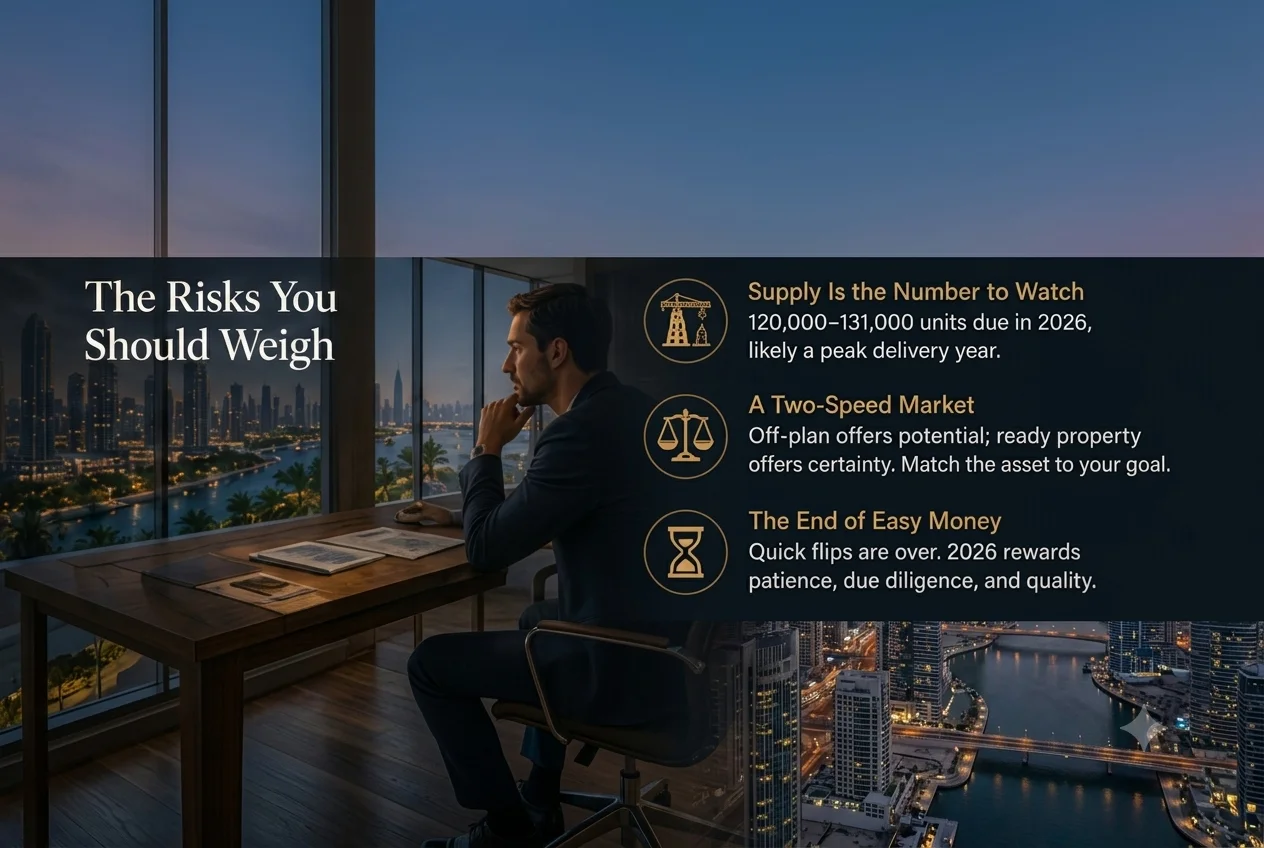
The single biggest variable for 2026 is new supply. Developers launched more than 150,000 units in 2025, and roughly 120,000–131,000 units are scheduled for handover in 2026, likely a peak delivery year. Where these completions concentrate — particularly in apartment-heavy communities — price growth could stall and rents could soften. Historically, however, actual handovers in Dubai have come in below forecast, which has repeatedly cushioned oversupply fears. The risk is real but localised, not citywide.
2, A two-speed market
Off-plan represented around 72% of residential transactions in 2025. Off-plan offers lower entry prices and flexible payment plans but carries completion and delivery risk. Ready property offers immediate rental income and certainty but at a premium. Neither is "better" — they suit different goals. The mistake in 2026 is treating the market as one thing; success now depends on matching the asset to your time horizon.
3. The end of easy money
If your plan relies on flipping for a quick 20% gain, 2026 is the wrong year. This is a market that now rewards patience, due diligence, and quality over momentum.
How to Invest Smart in 2026
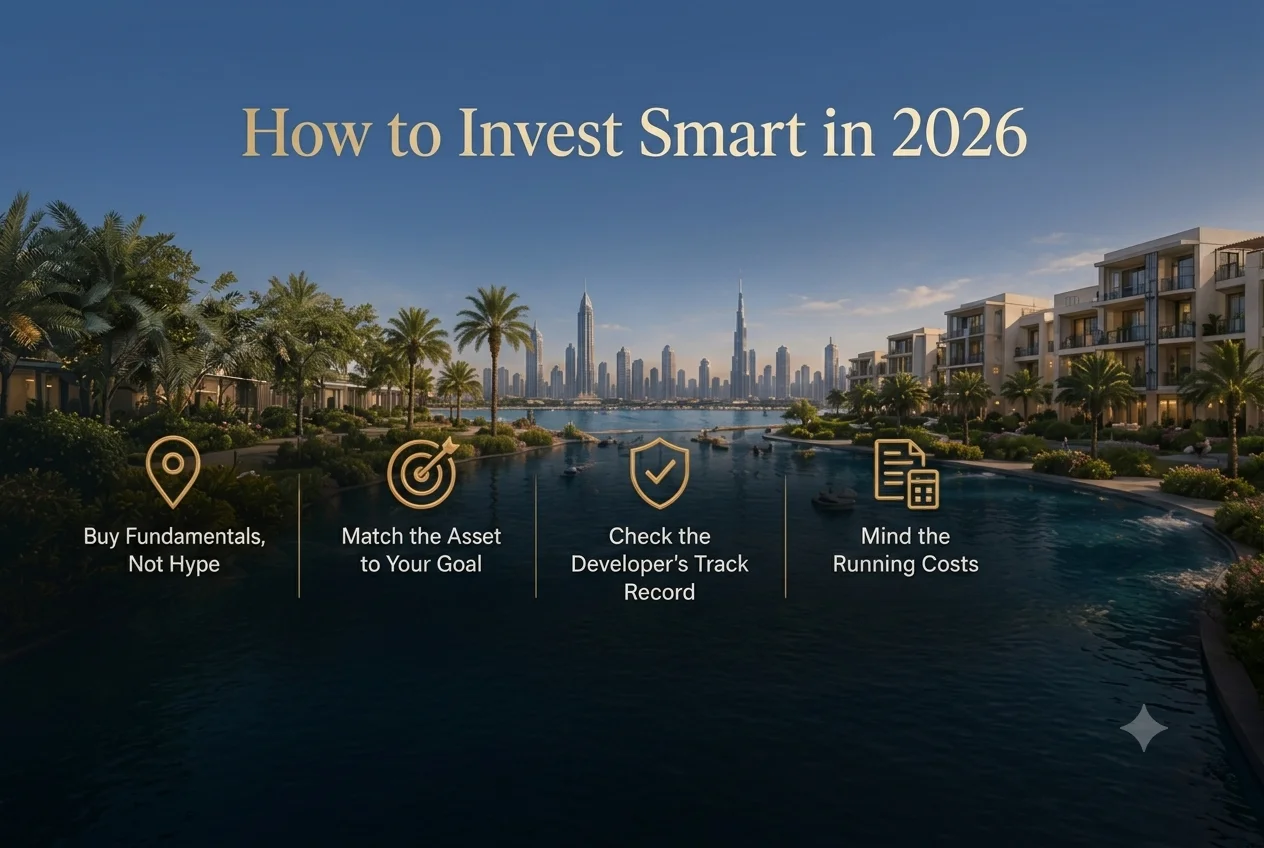
The throughline across every credible 2026 forecast is the same word: selectivity. Practically, that means:
- ● Buy fundamentals, not hype. Communities with schools, parks, transport links, and real tenant demand — Dubai Hills Estate, Arabian Ranches, JVC, Business Bay, Dubai Creek Harbour — tend to hold value best.
- ● Match the asset to your goal. Off-plan for long-horizon capital growth; ready property for immediate yield.
- ● Check the developer's track record. With buyers spoiled for choice, delivery credibility now separates winners from laggards.
- ● Mind the running costs. Service charges, fees, and management costs all eat into that attractive headline yield.
The Bottom Line
Dubai real estate in 2026 is still a good investment — arguably a smarter one than during the frenzied highs of recent years, because today's market gives buyers time, choice, and clarity. You're buying into a record-setting, well-regulated market with world-leading yields, zero income tax on rent, residency benefits, and strong economic fundamentals. What you should not expect is to get rich overnight. Treat it as the long-term, income-generating asset it has matured into, and the numbers stack up convincingly.
Ready to Invest With Confidence?
Choosing the right community, developer, and asset type is exactly where expert guidance pays for itself. FP Property brings nearly two decades of on-the-ground experience and a team of RERA-certified specialists across Dubai, Abu Dhabi, and the Northern Emirates. From exclusive off-plan launches and ready luxury homes to leasing and full property management, FP Property analyses every opportunity for ROI, rental demand, and long-term appreciation — so you invest on data, not guesswork.
Talk to us today and turn the 2026 market into your opportunity.
Frequently Asked Questions
Q. Is 2026 a good time to buy property in Dubai?
A. Yes, particularly for buyers with a long-term view. The market offers stable single-digit price growth, gross rental yields of roughly 5–8%, tax-free rental income, and Golden Visa eligibility. The rapid double-digit gains of 2024–2025 are moderating, so 2026 favours patient, fundamentals-led investors over short-term flippers.
Q. Will Dubai property prices crash in 2026?
A. A widespread crash is considered unlikely. Most analysts expect moderate growth of around 5–10% citywide, with possible softening only in specific communities receiving heavy new supply. Strong end-user demand, population growth, and a well-regulated market reduce the risk of a sharp correction.
Q. What rental yield can I expect in Dubai in 2026?
A. Gross yields generally range from 5% to 8%. Apartments in high-demand areas often achieve 6–8%, while villas tend to deliver 4–6% due to higher capital costs. These returns remain well above most major global cities.
Q. Do I get residency if I buy property in Dubai?
A. Yes. Buying property valued at AED 2 million or more can qualify you for the 10-year Golden Visa. Mortgaged properties may also be eligible, subject to documentation confirming the amount paid.
Q. Is off-plan or ready property the better investment in 2026?
A. It depends on your goals. Off-plan offers lower entry prices and flexible payment plans but carries completion risk, making it suited to long-horizon, growth-focused investors. Ready property generates immediate rental income and offers certainty, making it ideal for income-focused buyers.
Q. Are there taxes on Dubai property or rental income?
A. For individual owners, there is no annual property tax, no capital gains tax, and no income tax on rent — one of the market's biggest advantages for international investors.