
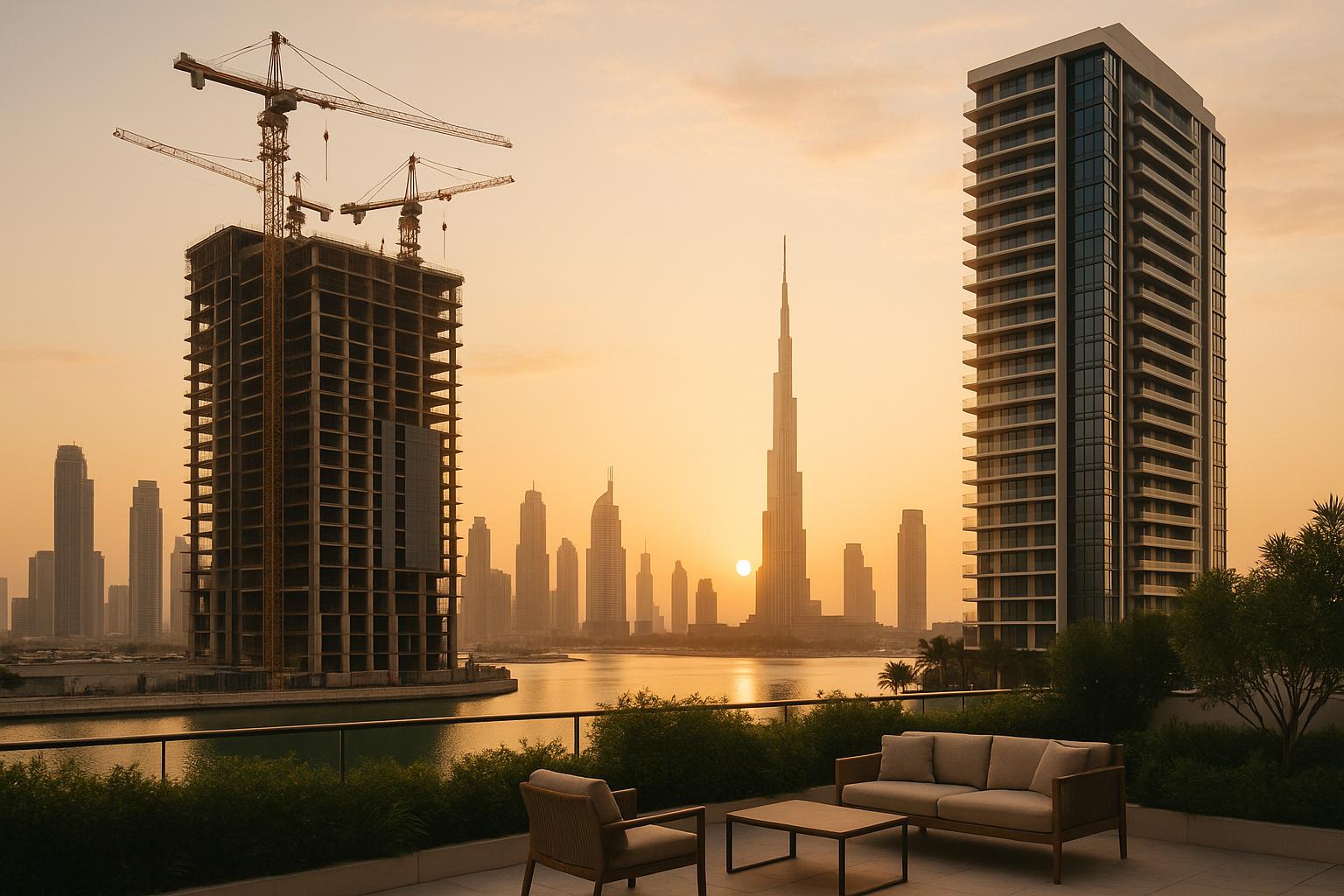
Investing in Dubai's real estate market boils down to two main options: off-plan properties and ready properties. Each caters to different goals, financial needs, and risk preferences. Here’s a quick breakdown:
- Off-plan properties: Lower upfront costs, flexible payment plans, and potential for high capital appreciation during construction. Ideal for long-term investors but comes with risks like delays or project cancellations.
- Ready properties: Immediate rental income, tangible assets, and lower risk. Best for investors seeking steady cash flow and quicker returns but requires higher initial investment.
Quick Comparison
| Feature | Off-Plan Properties | Ready Properties |
|---|---|---|
| Initial Cost | 15–30% below market value | Full market price |
| Income Generation | Starts after 2–5 years (6–10% yields) | Immediate rental income (4–10% yields) |
| Capital Growth | Up to 50% during construction | Steady, long-term growth |
| Payment Flexibility | Instalment plans (e.g., 80/20, 50/50) | Full payment or mortgage required |
| Risk Level | Higher (construction delays, etc.) | Lower (tangible asset) |
| Suitability | Long-term growth, higher risk tolerance | Immediate cash flow, lower risk |
Both options are promising as Dubai's population and demand for housing continue to grow. Your choice depends on your financial goals, timeline, and risk appetite.
Off-Plan vs. Ready Properties: A Guide for Dubai Real Estate Investors
1. Off-Plan Properties
Dubai's off-plan property market has seen remarkable growth, with sales increasing by over 60% year-on-year as of June 2024. Here's what you need to know to determine if off-plan properties align with your investment goals.
Pricing and Payment Plans
Off-plan properties in Dubai often come with pricing advantages, offering investors a more affordable entry point compared to ready-to-move-in units. Typically, down payments range from 10% to 20% of the property's value, and developers provide flexible payment plans, including post-handover options extending up to five years.
| Payment Plan Type | Structure | Benefits |
|---|---|---|
| 80/20 Plan | 80% during construction, 20% at handover | Lower upfront commitment |
| 60/40 Plan | 60% during construction, 40% at handover | Balanced payment distribution |
| 50/50 Plan | Equal split between construction and handover | Maximum flexibility |
| 90/10 Plan | 10% upfront, 90% at completion | Minimal initial investment |
Many developers now offer interest-free installment plans, reducing financing costs. Additionally, construction-linked payment plans release funds based on project milestones, which helps ensure accountability and minimizes risks related to delays. These payment structures make off-plan properties an appealing choice for investors seeking strong potential returns.
ROI and Investment Potential
Off-plan properties are attractive for their potential to deliver high returns. Thanks to lower initial purchase prices and the opportunity for capital appreciation as projects near completion, these properties have become a favorite among investors. In 2023, off-plan apartment transactions in Dubai surged by over 90%, while villa transactions increased by nearly 33%. These figures highlight growing investor confidence, with off-plan sales now contributing to more than half of all property transactions in the city.
The lower purchase price compared to ready units offers immediate equity. As construction progresses, property values typically rise, often reaching levels comparable to ready properties upon completion. This combination of capital appreciation and reduced upfront costs makes off-plan investments appealing, though they do come with risks that investors should be prepared to manage.
Risk Factors and Legal Considerations
While off-plan investments offer promising returns, they are not without risks. Delays or cancellations due to financial or regulatory issues can pose challenges. Developer insolvency is another concern, as it can jeopardize the project and your investment. Additionally, there is always a chance that the finished property may not meet the promised specifications or quality standards, and market fluctuations could impact property values during the construction phase.
Dubai's regulatory framework provides safeguards to protect off-plan investors. For instance, Law No. 8 of 2007 requires buyer payments to be held in escrow accounts, ensuring funds are secure during construction. The Real Estate Regulatory Authority (RERA) enforces stringent regulations on project registration and financial transparency. In June 2024, the Dubai Land Department fined three developers AED 500,000 for breaching off-plan sales regulations, demonstrating the authorities' commitment to investor protection.
To minimize risks, ensure payments go to registered escrow accounts, verify the developer's RERA registration, and confirm that sales are registered under the "Oqood" system. Negotiating clear completion dates with penalties for delays, including a long-stop date for final delivery, can also help safeguard your investment.
Market Demand and Buyer Suitability
Off-plan properties appeal to a wide range of buyers, particularly first-time investors, and international buyers, thanks to their lower initial costs and strong potential returns. Flexible payment plans make these properties accessible to both local and overseas investors. Post-handover payment options are especially popular, allowing buyers to secure properties without a large upfront financial commitment.
These investments are best suited for those with a higher risk tolerance and a longer-term investment outlook. Off-plan properties typically require a waiting period of two to four years for completion, demanding patience but offering the potential for significant capital appreciation upon project delivery. It's essential to evaluate your financial capacity carefully when choosing a payment plan to ensure you can meet all obligations. Maintaining open communication with the developer and keeping track of construction progress can further protect your investment.
2. Ready Properties
Ready properties in Dubai form a key part of the real estate market, offering immediate access to both physical assets and rental income. Unlike off-plan properties, these are fully constructed and often already occupied, allowing investors to start earning returns right away without waiting for construction to be completed.
Pricing and Payment Plans
Investing in ready properties typically requires a larger upfront payment, but the trade-off is immediate income and stability. As of Q3 2024, secondary market prices averaged AED 1,332 per square foot, compared to AED 1,558 per square foot in the primary market. This difference highlights the established nature and instant availability of ready properties. The market has been on a strong upward trajectory, with Dubai's residential property price index climbing 19.46% year-on-year by November 2024. During this period, apartment prices rose by 19.43%, while villa prices saw a 20.28% increase. By May 2025, the average villa price reached AED 3.4 million (up 12.1%), while average apartment prices settled at AED 1.3 million (a slight dip of -1.5%).
Payment for ready properties is straightforward, often involving either a one-time payment or a mortgage. This approach removes the uncertainties tied to construction timelines and provides the advantage of immediate ownership and returns. While the initial cost is higher, it sets the stage for a steady income and a strong return on investment (ROI).
ROI and Investment Potential
Ready properties are particularly appealing for their ability to generate rental income immediately, making them a great choice for investors focused on consistent cash flow. In high-demand areas such as Jumeirah Village Circle, Dubai Marina, and Business Bay, rental yields range between 7% and 9%, while prime luxury locations offer returns of 4% to 6%. Specific ROIs include:
- Jumeirah Village Circle: Approximately 8.64% for apartments and 7.18% for villas.
- Dubai Marina: Yields ranging from 7.5% to 9.5%.
- Business Bay: Around 5.76%.
- Dubai South: Approximately 8.29% ROI.
Unlike off-plan properties, which require a waiting period before generating income, ready properties start yielding returns almost immediately. This makes them a practical choice for offsetting higher upfront costs while ensuring financial stability.
Risk Factors and Legal Considerations
While ready properties offer clear advantages, there are still some risks to consider. These properties generally carry lower risks than off-plan investments since they are tangible and available for inspection. However, due diligence is essential. Investors should ensure the property has a valid title deed, a clean legal record, and reasonable service charges to avoid disputes.
The transfer process involves several steps, including signing a Sale Agreement (Form F) through a RERA-registered broker, obtaining a No Objection Certificate (NOC) from the developer, and completing the transfer at the Dubai Land Department. Associated costs include a 4% DLD registration fee and a real estate agent's commission of around 2%. While legal risks are minimal, issues such as post-purchase maintenance challenges or incomplete Land Department registration may arise. Engaging a trusted legal advisor can help mitigate these risks.
Market Demand and Buyer Suitability
Ready properties are especially attractive to investors looking for immediate returns over shorter investment periods. The secondary market for these properties remains strong, supported by established infrastructure, proven rental demand, and mature communities. They are ideal for buyers prioritizing cash flow over long-term capital appreciation, as well as international investors or owner-occupiers who value certainty and fully developed assets.
Additionally, purchasing either ready or off-plan properties may qualify investors for the UAE Golden Visa, provided the property meets the minimum price criteria. This added residency benefit makes ready properties even more appealing for those looking to establish a foothold in the UAE.
sbb-itb-dd15b90
Advantages and Disadvantages
When deciding between off-plan and ready properties in Dubai's fast-paced real estate market, it's essential to weigh the pros and cons carefully. Each option caters to different investor needs, risk tolerance, and financial strategies.
Off-plan properties come with notable benefits for those aiming for long-term growth and flexible payment terms. These properties are often priced lower than market rates, making them appealing to investors looking for a lower entry cost. Flexible payment plans, sometimes extending even after handover, add to their attractiveness. Additionally, the potential for capital appreciation is significant, with some properties appreciating by as much as 50% during the construction phase.
However, off-plan investments are not without challenges. Delays in construction, market volatility, and reliance on the developer's reputation can pose risks. Moreover, since these properties take 2–5 years to complete, investors must wait before earning any rental income, making them less suitable for those seeking immediate cash flow.
On the other hand, ready properties are ideal for investors looking for immediate returns. These properties generate rental income right away, providing a steady revenue stream. Buyers can inspect the property before purchase, ensuring quality and eliminating uncertainties. Established communities with developed infrastructure further enhance their appeal, offering proven demand in the rental market.
The downside to ready properties is the higher upfront cost. Since they are sold at full market value, buyers need to commit significant capital upfront or secure mortgage financing. Additionally, customization options are limited, as these properties come with fixed features.
| Feature | Off-Plan Properties | Ready Properties |
|---|---|---|
| Initial Cost | 15–30% lower than market rate | Full market price requires a higher upfront investment |
| Income Generation | Rental income begins after 2–5 years, with yields of 6–10% | Immediate rental income, with yields of 4–10% |
| Capital Appreciation | High potential, up to 50% during construction | Steady, long-term growth |
| Payment Flexibility | Offers installment plans, often post-handover | Requires 100% upfront payment or mortgage |
| Risk Level | Higher – depends on developer reliability | Lower – tangible asset inspection is possible |
| Customization | Possible during construction | Limited to fixed features |
| Market Availability | High–frequency new launches | Limited stock, but immediately available |
Each of these property types serves a unique purpose in Dubai's ever-evolving market. Off-plan properties are better suited for those who can wait for construction to finish and are comfortable with higher risks in exchange for potentially greater rewards. Meanwhile, ready properties cater to those prioritizing immediate income and lower risk.
Ultimately, the right choice depends on your financial goals, cash flow needs, and investment timeline. With Dubai's real estate market projected to grow by 5% in 2025, both off-plan and ready properties are positioned to offer promising opportunities. Balancing these factors will help you make a decision that aligns with your objectives.
Conclusion
Dubai's real estate market presents distinct opportunities for investors through off-plan and ready properties, each tailored to suit different financial goals and timelines. The decision between the two depends on factors like your investment horizon, risk appetite, and cash flow preferences, allowing you to craft a strategy that aligns with your objectives.
Ready properties are ideal for those seeking immediate rental income, with average gross rental yields ranging from 6–8%, depending on the location. Plus, the ability to physically inspect the property before purchase reduces uncertainty, making it a safer choice for investors who prioritize tangible assets and quick returns. On the other hand, off-plan properties cater to those with a long-term outlook, offering lower initial costs and the potential for 10–15% annual appreciation during construction. Some investors have even achieved capital gains of 20–40% between the launch and handover stages, showcasing the potential for substantial growth over time.
Recent data underscores growing investor confidence in Dubai's real estate pipeline, reflecting the city's appeal as a global investment hub.
To summarise, here are some recommendations based on your investment priorities:
- Off-plan properties: If your focus is long-term growth, you can handle construction risks, prefer flexible payment options, and prioritize capital appreciation over immediate income; this route may suit you. However, ensure you thoroughly vet the developer's track record.
- Ready properties: If you need instant rental income, value the ability to inspect the property, have a lower risk tolerance, or require quicker liquidity, ready properties are likely a better fit. Be sure to evaluate rental demand in the area before committing.
For seasoned investors, diversifying with a mix of off-plan and ready units can provide a balanced approach, combining immediate income with long-term capital growth.
Ultimately, the key to a successful investment lies in aligning your property choice with your financial goals, timeline, and risk tolerance. Dubai's dynamic market offers opportunities for all kinds of investors - it's just a matter of finding the right fit for your strategy.
FAQs
What are the key risks of investing in off-plan properties in Dubai, and how can investors reduce them?
Investing in off-plan properties in Dubai has its challenges. Common risks include construction delays, market fluctuations, developer reliability, and potential legal or regulatory hurdles. These issues can impact your investment's timeline, value, and overall security.
To minimize these risks, start by digging into the developer's history - look for a solid track record of successful projects. Make sure your funds are protected in a secure escrow account, and check that the project aligns with RERA regulations. Choosing well-known developers and keeping an eye on construction updates can also give you more peace of mind. By taking these precautions, you'll be better equipped to protect your investment and navigate the process with greater confidence.
What are the differences in potential returns between off-plan and ready properties in Dubai?
In Dubai's thriving real estate market, off-plan properties often present an opportunity for higher returns compared to ready-to-move-in properties. These properties are typically priced 15–30% lower during the pre-construction phase, giving investors a chance to benefit from capital appreciation as the development progresses. In some cases, returns on investment (ROI) can climb by 20–30% as the project nears completion.
Meanwhile, ready properties are known for providing consistent rental income, with average yields ranging between 8–9%, depending on the location and demand within the market. While off-plan investments come with higher risks - such as construction delays and market shifts - they can be a solid choice for those focused on long-term growth. On the other hand, ready properties are ideal for those seeking immediate rental income and a lower-risk investment. Ultimately, the decision between the two boils down to your financial goals and how much risk you're willing to take on.
What should I consider when choosing between off-plan and ready properties in Dubai to meet my investment goals?
When choosing between off-plan and ready properties in Dubai, it's important to consider your financial goals and how much risk you're willing to take. Off-plan properties are usually priced 10–30% lower than ready properties, making them an attractive option for those looking for potential capital growth. That said, they come with certain risks, such as project delays or changes in market conditions.
On the flip side, ready properties offer the advantage of immediate rental income and come with fewer uncertainties. However, they typically require a larger upfront investment and may have limited potential for value growth compared to off-plan options.
To make an informed decision, think about factors like your budget, investment timeline, and how comfortable you are with market risks. It’s also worth assessing Dubai's regulations, market trends, and available payment plans to ensure your choice supports your long-term financial goals.