
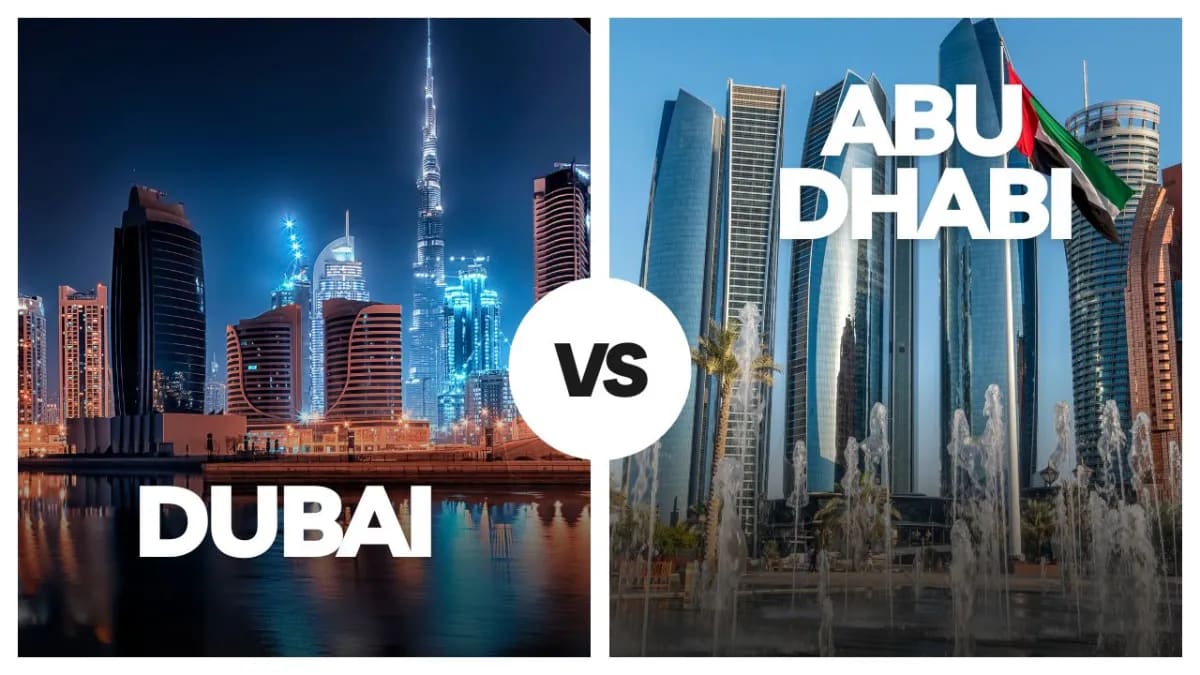
Dubai and Abu Dhabi are two of the most prominent cities found in the UAE, and both cities have their own appeal as well as advantages in terms of living lifestyle.
Dubai (which is a global hub) is known for innovation, skyscrapers, and international business opportunities. And Abu Dhabi, the capital of the UAE, is administrative, cultural, and more traditional in the way that cities are organised. Both emirates are attractive to expats, investors, and families, but the cost of living is a deciding factor when considering them.
Understanding the financial aspect of what one spends on rent, schooling, utilities, and property investment is fundamental for any kind of person thinking of relocating and investing. This guide gives detailed insights into 2026 market trends and helps readers make informed decisions. Our experience as a Dubai-based real estate brokerage enables us to comprehensively analyse both emirates, with actionable insights for accommodation, property purchase, and lifestyle choices.
Best Differences Between Dubai And Abu Dhabi
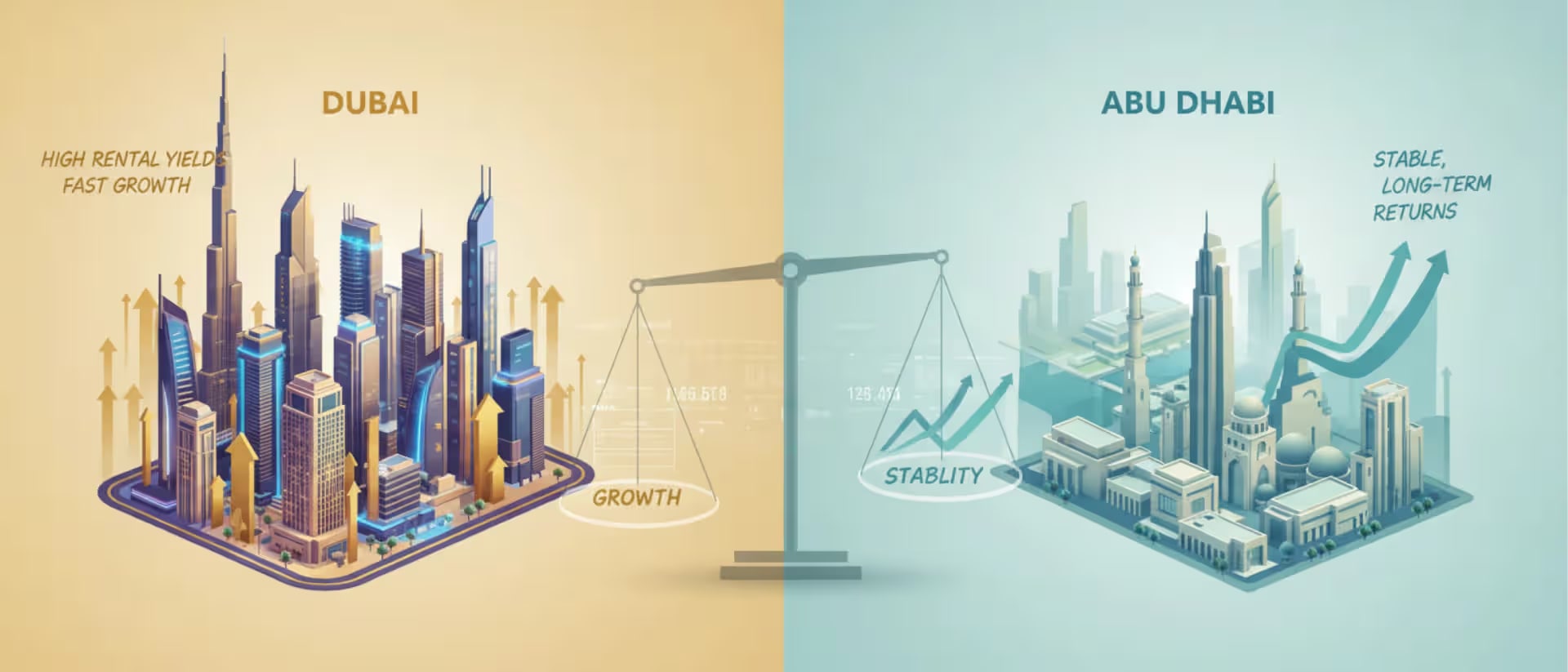
Dubai and Abu Dhabi are not only geographically different but also economically focused and culturally different from each other. Dubai is very commercialised, with lots of jobs in the market, a globalised, fast-paced lifestyle, etc. It is appealing to young professionals, entrepreneurs, and foreign investors seeking dynamic opportunities. Abu Dhabi is, by contrast, the administrative and cultural capital. Its economy is reliant upon government, financial, and energy sectors. Life here is more relaxed at a slower pace of life. That is good for families, kids, and long-term residents who are looking to establish themselves in the long run.
Differences in lifestyle are noticeable. Dubai is an international and cosmopolitan place and offers a great choice of entertainment and nightlife activities as well as shopping. Abu Dhabi specialises more in cultural experiences and public amenities, and suburban-style living.
Expats and investors prefer Dubai for career purposes and to earn short-term high returns, but Abu Dhabi is attractive to families or those who want to invest on a predictable long-term basis.
Abu Dhabi vs Dubai rent comparison
Rent can be one of the main monthly costs and the biggest concern of expats. In the year 2026, rental prices in Dubai are still a little higher on average than in Abu Dhabi, although not always, and it depends on the area and the type of property.
Average Rents:
Studios:
Dubai - AED 35,000 - 50,000/year
Abu Dhabi - AED 30,000 - 45,000/year
1BR:
Dubai - AED50-80K/year
Abu Dhabi - AED 50-70K/year
2BR:
Dubai - AED 80,000 - 140,000 / year
Abu Dhabi - AED 70,000 - 120,000/year
3BR:
Dubai - AED 140,000 - 250,000 / year
Abu Dhabi - AED 120,000 - 200,000 / year
Prime Areas Cost Variations:
Dubai:
The most expensive in terms of rentals are the central districts, namely Downtown Dubai, Dubai Marina, Business Bay, and Palm Jumeirah, with a price of a 2-3 BR apartment of more than AED 200,000/year in some of the buildings.
Abu Dhabi:
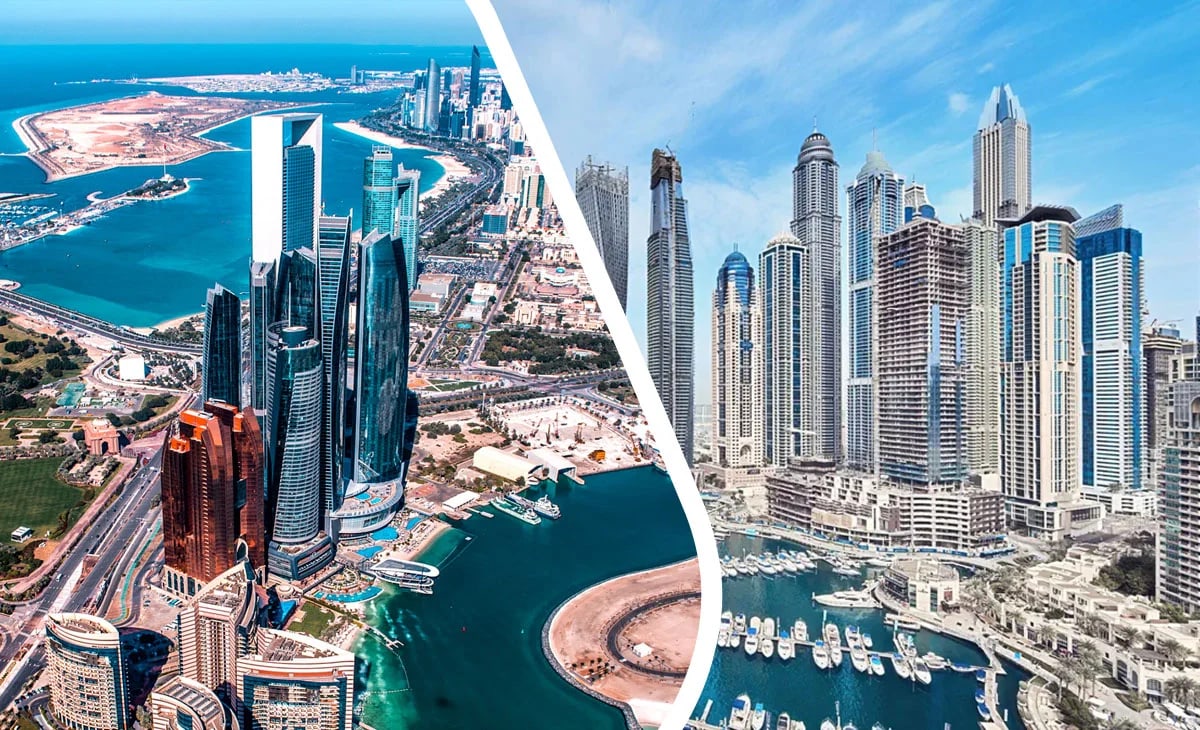
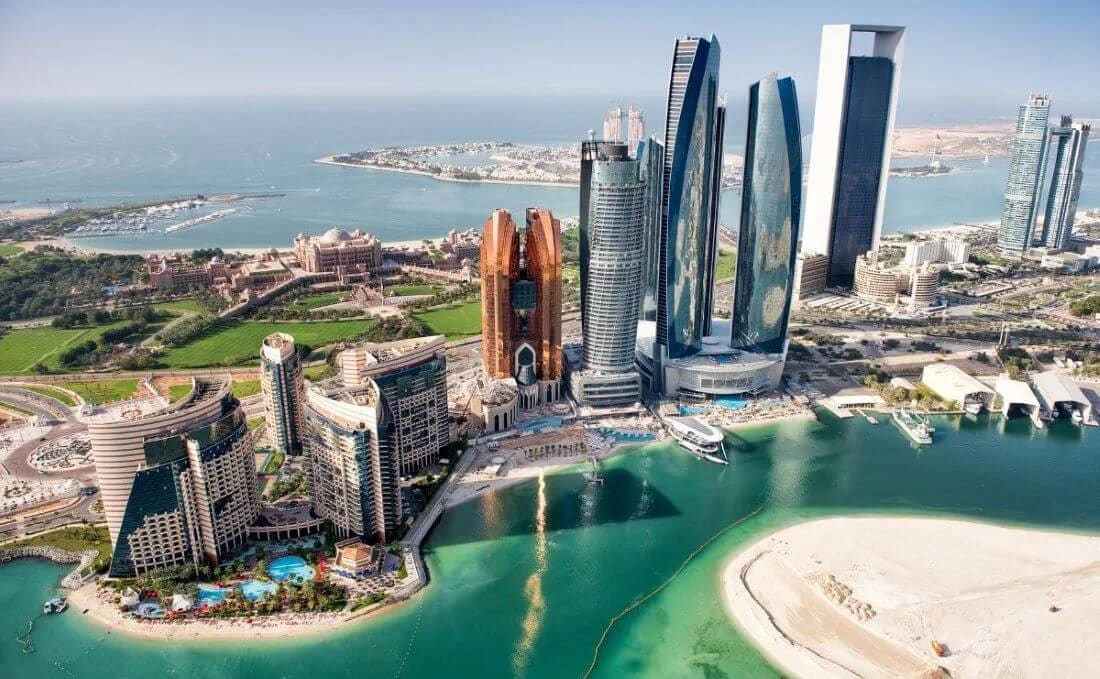
Al Reem Island, Saadiyat Island, and Al Raha Beach consist of great offers for waterfront living, with costs remaining 10-15% less than what would be found for equal properties in Dubai.
Inexpensive Areas Cost Differences:
Dubai:
JVC, Al Furjan, IMPZ & Mirdif are the more affordable options and are more attractive to more mid-budget expats.
Abu Dhabi:
Khalifa City, MBZ, and Al Shamkha – They offer a good amount of large apartments and villas at reasonable prices and are often more cost-effective than mid-range neighbourhoods in Dubai.
Additional Cost Factors:
There are variations in security deposits, agency commissions, and contract registration fees. Dubai has Ejari registration in the case of tenancy contracts, and in Abu Dhabi, Tawtheeq is implemented. Agency fees are generally one month's rent in Dubai and a bit less in Abu Dhabi. Lease contracts usually last for a period of one year, but off-plan or furnished units may have flexible contracts.
Utilities, Transportation & Cost of Daily Living
Utilities:
There is a slight difference in electricity and water costs. DEWA in Dubai has higher peak tariffs, especially during the summer when we use the AC more. In Abu Dhabi, ADDC rates are slightly lower, even in the suburban areas of villas, though bigger villas do use more energy, and hence, the monthly bills can be similar under the extreme heat.
Transportation:
Dubai's metro is an economical way of getting around, which is not the case in Abu Dhabi. There are buses, taxis, and ride-hailing apps running in both cities. Professionals who travel between emirates may spend more, especially if they are accompanied by a private car and tolls, such as Salik in Dubai.
Groceries & Essentials:
Basic goods like milk, vegetables, eggs, and chicken are slightly cheaper in Abu Dhabi. Dubai is a case in point. Supermarket chains vary: Carrefour, Spinneys, Waitrose, and giant hypermarkets exist, and Lulu, Choithrams, and smaller premium shops exist in Abu Dhabi. For overall grocery bills, depending on the lifestyle, they may be anywhere from 5% to 10% different.
Schooling & Healthcare:
International school costs are often higher in Dubai, especially for the best curricula. Competitive fees are charged in the schools of Abu Dhabi, although the most expensive areas (called premium zones) are located on islands such as Saadiyat Island. Health insurance costs are broadly similar and mandatory for residents in the Emirates. Private healthcare is available, but there are more clinics and hospitals of international health standards in Dubai.
Lifestyle Comparison: Dubai and Abu Dhabi
Lifestyle costs are the choice of the city. Combining fast-paced entertainment, nightlife, and luxury experiences as part of the consumer's experience, Dubai residents frequently pay for luxury. Abu Dhabi spending is more skewed towards cultural activities, family outings, and more laid-back recreation.
Restaurants:
The average cost of different meals is more in Dubai, while mid-range and fine dining are more expensive in Dubai, with a cost of more than AED 400 per person and AED 300-350 in Abu Dhabi.
Entertainment:
Dubai has concerts, international events, and international entertainment and shows, whereas Abu Dhabi is more museum- or exhibition-oriented and kid-friendly.
Fitness & Wellness:
Fitness club memberships are AED 200 - 600/month in both cities, but a nominal bit more for boutique fitness studios in Dubai.
Shopping & Luxury:
Dubai possesses larger malls and designer shops and luxury, which makes people spend more on discretionary items.
Overall, the city of Dubai is more international and cosmopolitan, with higher levels of optional spending, and Abu Dhabi is a quieter, family-orientated one with slightly smaller levels of discretionary spending.
Employment & Differences in Income
Salaries differ according to the sector and the emirate. Due to global demand, Dubai's private sector tends to pay more for positions in finance, hospitality, tech, and real estate businesses, for instance. Abu Dhabi contributes more to the sectors of energy, government, and finance.
Average salaries (2026 estimates):
Dubai:
AED 15000-AED 30000/month for mid-level professionals; AED 50000+ for top positions
Abu Dhabi:
AED 12,000 - 28,000 / month for similar jobs; senior government or energy jobs can bring in more than AED 45,000.
Dubai is for young professionals who are looking for greater salary-to-living cost ratios and who take advantage of rental options for better short-term gain. Abu Dhabi is interested in people looking for stability in the long run, the government, and the energy industries.
Property Investment: Which Emirate Has Better ROI?
Investment returns vary in their structure and risk profile.
Investment Metrics:
Price per sq ft:
In Dubai, the real estate properties vary in price from AED 1,000 to AED 3,000 per square foot, depending on their location and the type of building and community. Prime areas such as Downtown Dubai, Palm Jumeirah, and Dubai Marina are on the higher end of this range, whilst emerging or suburban neighbourhoods such as JVC and Al Furjan are on the lower end.
The price is a bit less in Abu Dhabi, and this will typically be between AED 900 and AED 2,500 per square foot. Premium areas such as Saadiyat Island and Al Raha Beach do come with a higher price tag, but suburban areas such as Khalifa City and MBZ do not come quite as pricey yet have a spacious layout, which is why there is more interest from long-term buyers who are seeking an additional space and stability in Abu Dhabi.
Rental yields:
Dubai does offer rental yields between an average of 5% and 7%, and these numbers do vary depending on the type of property and its location. High-demand areas, such as Business Bay or Dubai Marina, can expect to receive better returns, but some of the ultra-luxury developments do not always yield a better return due to the increased purchase price.
Abu Dhabi's rental yields average 4-6%, slightly less than compared to Dubai; however, they are more stable over time. Properties in places like Al Reem Island and Masdar City have a constant demand for rental, and this makes them attractive for investors looking for regular income, rather than speculation.
Vacancy rates:
Dubai's vacancy rates go up and down depending on market cycles, new supply, investor activity, and economic trends. Some areas may be high-end or new developments, and there will likely be temporary vacancies, particularly in situations of oversupply.
In contrast, Abu Dhabi has higher levels of state occupancies, which is the result of a long-term expat base, which is more stable; the pace of new development is slower, and demand in the residential as well as the luxury sector seems constant. This stability makes Abu Dhabi attractive to investors who are seeking predictable rental income with less risk involved.
Future growth: Dubai's short-term growth is due to tourism and mega-projects; Abu Dhabi has long-term government planning in place and eco-development.
Dubai Strengths:
-
● High global demand
-
● Freehold zones and short-term rentals (Airbnb)
-
● Large developer inventory with flexible investment options
Abu Dhabi Strengths:
-
● Stable long-term expat base
-
● Saadiyat & Yas Island projects Generating Potential
-
● New Freeholders' alms areas for expatriates
-
● Predictable rental yields and decreased vacancy
Overall, Dubai has a higher immediate ROI potential with more dynamic capital gains, while Abu Dhabi has stability and long-term value preservation.
Long-Term Living Quality of Life Differences
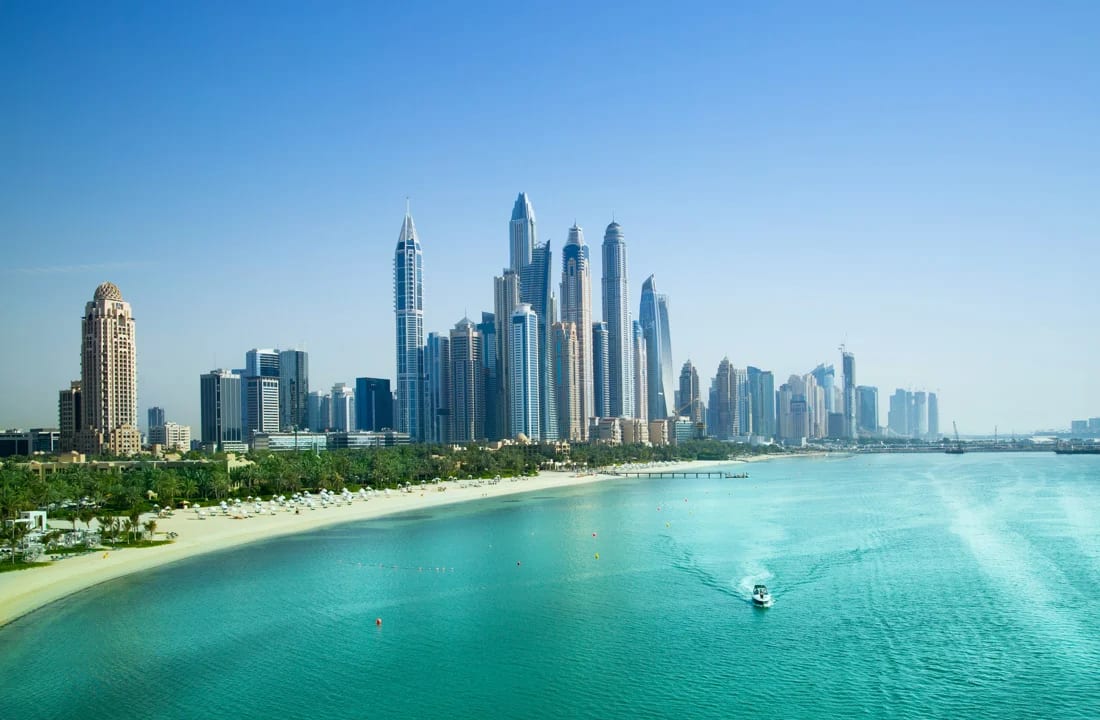
Quality of life is dependent on the community, commute, and the cultural environment. Dubai is not just well-populated, but it also has cosmopolitan neighbourhoods. These are short distances to business centres as well as rich areas. Whereas Abu Dhabi is more diverse in neighbourhoods, its streets are safer, and it has a more serene atmosphere. Both are multicultural Emirates, with Abu Dhabi's being a bit slower paced in the design, which is good for the families living there. Working life is also generally easier in Abu Dhabi due to the decrease in traffic and density of housing.
Cost Of Property Purchasing: Dubai vs Abu Dhabi
Dubai:
-
● DLD registration fees are 4% of the price of the property.
-
● NOC fees AED500 - 5000, based on the developer
-
● The mortgage processing process and interest rates differ based on individual banks.
-
● Charges for services in premium communities can be AED 25-50 per sq ft a year.
Abu Dhabi:
-
● ADREC registration fees: 2-3%
-
● Freehold vs. leasehold rules – freehold increasingly available to expats
-
● Service charges are slightly less than average in Dubai.
-
● Developers often have structured payment terms that come with flexible payments.
Dubai buying costs are higher in the front end but offer rental interest globally, whereas Abu Dhabi is lower risk with slower capital growth but predictable expenses.
Which Emirate is Best for Family, Profession, and Investors?

Families:
Abu Dhabi is ideal for families, as the lifestyle is slower and the neighbourhoods are more spacious. Many neighbourhoods provide huge parks, clean public spaces, and well-rated schools that provide comfort in day-to-day living. The city is also known for both safety standards and family-friendly planning, which gives a sense of stability to long-term residents. For those families who value space, silence and a predictable quality of life, Abu Dhabi emerges as a natural choice.
Young Professionals:
Dubai is the one-stop destination for young people in the field of business due to its booming job market, a wide range of industries and constant inflow of opportunities from around the world. The city presents a broad lifestyle mix ranging from social and dining centres to fitness centres and co-working spaces. Networking is easier, as the business scene is on the move and very international. For people who are early in their careers or are seeking fast career development, Dubai offers the right combination of career development and city life.
Dubai stands out for investors because of the increased global demand, the variety of freehold communities and favourable short-term rental prospects, particularly in the tourist areas. The market provides better return on investment prospects and constant capital gains.
Abu Dhabi, on the other hand, appeals to investors who are seeking steady and predictable returns. With there being fewer risks of vacancies and a monopolised expat long-term population, a slower but more constant pace is run by the market. Both of these emirates have their advantages, but it depends on whether the investor wants high growth opportunities or long-term stability.
Dubai Vs Abu Dhabi Cost of Living Analysis
Dubai is usually accompanied by higher spending, particularly with respect to rent and lifestyles and spending on discretionary items. Prime areas, such as Downtown Dubai, Dubai Marina and Palm Jumeirah, command top rents, with dining, entertainment and leisure activities being more expensive. However, higher pay and business opportunities across the world, as well as a booming property market, often outweigh these costs to make Dubai an attractive destination for young professionals and career-minded expats, as well as investors looking for good returns and short-term rental options.
Abu Dhabi, on the other hand, has a slightly lower cost of living for rent, groceries and utilities. Suburban areas like Khalifa City, Al Raha Beach and MBZ provide a space of housing for more reasonable prices. Life in Abu Dhabi is calmer, safer and more family-orientated with stable rental yields as well as predictable long-term investment growth. While in Dubai and the private jobs, the salaries may be a little low, but the emirate has attractiveness for the family, people who wish to stay long term, and investors who want steady returns and an equilibrium of life.
FP Property Expert Advisory: Helping You Pick the Right Emirate
FP Property provides expert advice and guidance on renting, buying, or investing in all parts of Dubai and Abu Dhabi. Our team assists in neighbourhood evaluation, ROI Return on Investment, and transparent consultation of all such costs. Whether you're looking to buy a family home, a professional accommodation, or a high-yield property investment, our free consultation services guarantee that you make the right decisions according to lifestyle, budget, and long-term goals. Check out listings today or contact FP Property to find your best options in the UAE real estate market.